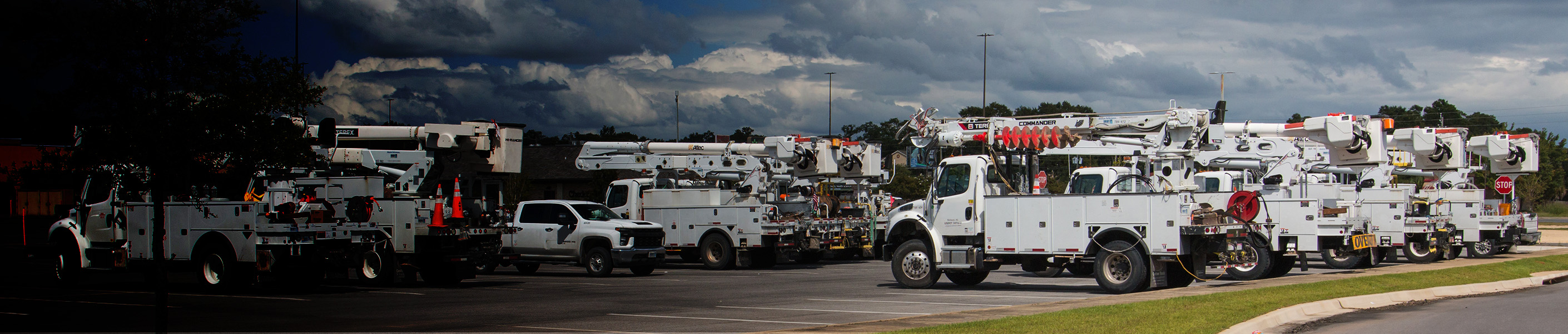
Our Priority Approach To Power Restoration
After a storm, our top priority is restoring power quickly, safely, and efficiently—starting the moment conditions are safe. We follow a proven process that prioritizes public safety, essential services and restoring power to the greatest number of customers as fast as possible.
While our restoration process follows a general sequence, it’s not strictly linear. Because the electric infrastructure is complex and interconnected, crews often work on multiple steps at once across different areas.
For example, repair in one area may affect power in another. Conditions like flooding, debris and safety hazards can shift priorities in real time.
Each grid component must be working for electricity to reach homes and businesses.
- Power plants generate electricity.
- Transmission lines carry it over long distances.
- Substations reduce the voltage for safe distribution.
- Distribution lines deliver electricity to neighborhoods, homes and businesses.
How We Restore Power After a Storm
Assess Damage and Prioritize Repairs: After a major storm, it may take a while before you see crews restoring power near you. That’s because we first assess damages, determine our ability to access them, prioritize areas for repair and assign resources to complete the work.
Restore Critical Infrastructure: We begin by repairing any damage to power plants, transmission lines and substations. Without these in working order, electricity can’t reach you.
Repair Distribution Lines: Next, we repair distribution lines, prioritizing those that serve essential services like hospitals, fire and police stations, water treatment plants and major transportation facilities. Since our grid is interconnected, repairs to these areas can also restore power to nearby homes and businesses. We then focus on the remaining distribution lines, prioritizing those that serve the most customers and are easiest to fix—so as many people as possible get power as quickly as possible. This is the stage when our crews are most visible in the community.
Fix Isolated Outages: Once major repairs are complete, we focus the more complex and isolated issues—such as those affecting single streets or individual service connections.
Our work doesn’t stop until everyone’s power is restored.
Estimated Restoration Time
After a major storm, Tampa Electric provides an estimated restoration time, which is the projected date and time when we expect to restore power to most customers who can safely receive it. In some cases, we provide estimated restoration times specific to different areas within our region. Our estimates can sometimes change as conditions evolve during the restoration process.
How We Estimate It
We consider:
- The extent and location of storm damage
- The number of repair crews that can safely work on our system
- Safety conditions across the system
Why Your Power Might Still Be Out
Even if your area has power, your home may not if:
- Repairs are needed at multiple points along your service line
- You’re on a different line than nearby homes
- There’s damage to your meter or electrical equipment
Learn more about our power restoration process.
Experiencing a power outage?
Visit our outage map to report and track outages in your neighborhood. You can learn the cause and restoration status in addition to the number of customers affected and the estimated restoration time.